Prepared by Dr. Sandip Kumar
Consultant of General and Colorectal Surgery
Gleneagles Hospital Johor
What Is Colorectal Cancer?
Colorectal cancer is a type of cancer that develops in the colon or rectum due to the uncontrolled growth of cells. It is one of the most common cancers globally, with symptoms that may include changes in bowel habits, blood in the stool, abdominal pain, and unexplained weight loss. Early stages of colorectal cancer may not present any symptoms, which is why screening is essential for early detection.
In Malaysia, it is the most common cancer in males and the second most common amongst females. The incidence is highest among the Chinese population, followed by Malays and Indians. The general population faces a lifetime risk for developing the disease of about 5 percent, while someone whose family has a history of colorectal cancer has a 10 to 15 percent chance of developing the disease. The risk rises to over 50 percent in people with inflammatory bowel disease (IBD) and those whose family members harbour specific genetic mutations.
Colorectal cancer affects both men and women with almost equal frequency. However, the survival rate is closely linked to the stage of colorectal cancer at diagnosis. Unfortunately, the majority of Malaysian patients with colorectal cancer present at an advanced stage. Colorectal cancer is usually preventable, highly treatable, and often curable, especially when detected early.
Regular screening and early intervention are key to improving survival rates and reducing the impact of this disease.
What Are The Symptoms of Colorectal Cancer?
Colorectal cancer is often a silent disease, developing with no obvious symptoms in the early stages. However, as the disease progresses, the following colorectal cancer symptoms may occur:
- Blood In, or On the Stool: One of the most common signs of colon cancer.
- Change in Bowel Habits: Persistent diarrhea, constipation, or alternating between the two.
- Stools that are Narrower than Usual: This may indicate a blockage or narrowing of the colon or rectum.
- General Stomach Discomfort: bloating, fullness, cramps or gas that does not go away.
- Vomiting: Occurs when the cancer affects other organs, like the stomach, or causes a blockage.
- Diarrhoea, Constipation, or feeling that the bowel does not empty completely.
- Weight Loss for No Apparent Reason: Unexplained weight loss may be caused by colon cancer or other underlying issues.
- Constant Tiredness, or Fatigue: This may develop as a result of blood loss from tumors or the body’s response to cancer.
If you have any of these symptoms for more than two weeks, see your doctor or health professional immediately for an early colorectal cancer diagnosis. Early detection can lead to better outcomes and higher colorectal cancer survival rates.
Can Colorectal Cancer Be Prevented?
Yes, colorectal cancer can often be prevented, especially in cases linked to polyps. Polyp-related colorectal cancer develops from benign growths called polyps (mushroom-like growths on the lining of the colon and rectum). By removing these polyps before they become cancerous may prevent cancer from developing. Regular screening, such as a colonoscopy, is crucial for detecting polyps early and preventing their progression to colon cancer or rectal cancer.
Additionally, lifestyle changes, including maintaining a healthy diet, regular exercise, and avoiding smoking, can further reduce the risk of developing colorectal cancer.
Who Is At Risk of Colorectal Cancer?
The risk of developing colorectal cancer increases with age. All men and women aged 50 and older are at risk and should begin colorectal cancer screening. However, some people are at a higher risk and should be screened at an age younger than 45, including those with a personal or family history of:
- Inflammatory bowel disease (IBD)
- Colorectal cancer or polyps
- Ovarian, endometrial, or breast cancer
Other factors that increase the risk of colorectal cancer include smoking, diabetes mellitus and obesity. These lifestyle factors can further elevate the chances of developing colon cancer or rectal cancer.
How Do I Get Checked For Colorectal Cancer?
Regular colorectal cancer screening is essential for early detection and improving treatment outcomes. The most common methods for checking for colorectal cancer include:
- Fecal Occult Blood Testing (FOBT): A simple chemical test that detects hidden blood in the stool, which could be an early sign of colon cancer or rectal cancer.
- Colonoscopy: The most comprehensive method for diagnosing colorectal cancer. During this procedure, a doctor uses a camera to visually examine the entire colon for abnormal growths, such as polyps or tumors. If any abnormalities are found, such as polyps, they can often be removed during the colonoscopy, reducing the risk of developing cancer in the future.
- Digital Rectal Exam (DRE): A physical exam where a doctor checks for abnormalities in the rectum and lower colon. This is commonly used alongside other screening methods.
Currently, there are no reliable blood tests for diagnosing colorectal cancer, making colonoscopy the gold standard for colon cancer diagnosis and prevention.
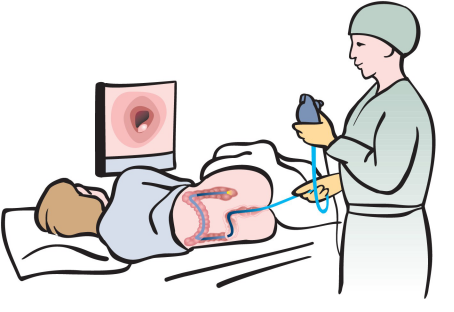
Colonoscopy is performed under sedation for diagnosis and prevention of colorectal cancer.
How Is Colorectal Cancer Evaluated And Staged?
Once a diagnosis of colorectal cancer is made, your doctor needs to know the extent (clinical stage) of the disease to plan the most effective treatment. The stage is based on whether the tumor has invaded nearby tissues, whether the cancer has spread and, if so, to what parts of the body. When colorectal cancer spreads outside the colon or rectum, cancer cells are often found in nearby lymph nodes. After spreading to the lymph nodes, colorectal cancer cells most often spread to the liver. Doctors call this "distant" or metastatic disease.
In addition to taking a personal medical and family history and performing a physical exam, your doctor may order the following tests:
- Blood Tests: These may include complete cell counts (to check for anemia), and CEA (carcinoembryonic antigen) level. Some colon cancers produce CEA, which is useful in detecting cancer recurrence.
- CT (Computed Tomography) Scan, MRI (Magnetic Resonance Imaging), and PET (Positron Emission Tomography) Scans: These are useful for determining whether cancer has spread to the liver, lungs, or other organs.
Stages of Colorectal Cancer
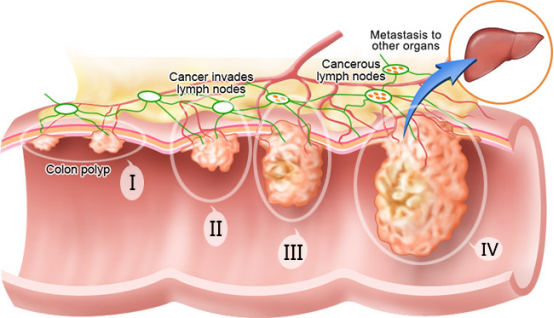
Colorectal cancer progresses through several stages, each indicating the extent of cancer spread. The stages are as follows:
- Stage I: Colon polyp, localized growth, no spread.
- Stage II: Cancer spreads to surrounding tissues.
- Stage III: Cancer invades nearby lymph nodes.
- Stage IV: Metastasis to other organs (e.g., liver).
This progression highlights the importance of early detection and screening for effective treatment and improved survival rates.
How Is Colorectal Cancer Treated?
The primary treatment for colorectal cancer is surgery, with the specific approach depending on the location and the stage of the cancer. Colorectal cancer can be cured in up to 90 percent of people when it is discovered in its early stages. Surgical removal of the tumor is often highly effective, especially for early-stage colorectal cancer.
In advanced colorectal cancer, particularly rectal cancer, radiation therapy is often used prior to surgery to shrink the tumor and make it easier to remove. Chemotherapy, or a combination of treatments, may also be used, particularly if the cancer has spread to other parts of the body.
Treatment plans are tailored to each patient based on the colorectal cancer staging, and may involve a combination of surgery, radiation therapy, and chemotherapy to maximize the chances of successful treatment and recovery.
How Is Surgery For Colorectal Cancer Performed?
Surgical removal of the affected portion of the colon or rectum is the most common and effective treatment for colorectal cancer. This surgery can render many patients disease-free without the need for additional therapy.
Two main surgical approaches for treating colorectal cancer are:
- Laparoscopy: In this minimally invasive surgery, a thin, lighted tube (a laparoscope) is inserted through small incisions in the abdomen. The laparoscope is connected to a video screen, allowing the surgeon to remove the tumor with great precision. This approach requires only three or four tiny cuts, leading to less post-operative pain and a shorter hospital stay.
- Open Surgery: In more complex cases, the surgeon makes a larger incision on your abdomen to remove the tumor and part of the healthy colon or rectum. While this approach may be necessary for advanced or larger tumors, it typically involves a longer recovery time compared to laparoscopic surgery.
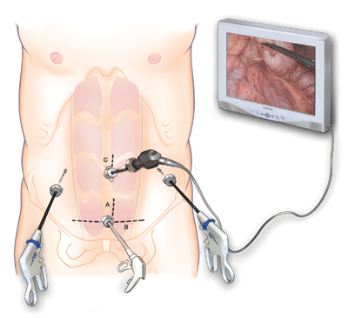
Laparoscopic surgery has significantly reduced post-operative pain and length of hospital stay after colorectal cancer surgery, making it the preferred choice for many patients with early-stage colorectal cancer.
Early Detection and Treatment of Colorectal Cancer at Gleneagles Hospital Johor
Colorectal cancer is a common malignancy that causes a significant number of deaths globally. However, it is potentially preventable through regular screening and highly curable with surgery alone when diagnosed at an early stage. Modern chemotherapy continues to improve survival for patients with more advanced stages. Colorectal cancer treatment often requires a team approach, including colorectal surgeons, oncologists, radiologists, and pathologists. These doctors work with the patient to create the safest and most effective therapy plan.
If you're concerned about your risk or need to schedule a screening, visit Gleneagles Hospital Johor. Our team of experts is here to guide you through every step of prevention, diagnosis, and treatment to ensure the best care possible for your health.




 EN
EN
 e-Shop
 Find A Doctor
 Request an Appointment
 International Patient
 +607 560 1000
 +607 560 1111